From powder prep to sealing — the errors that kill your first batch, and exactly what to do instead.
You ordered a capsule filling machine, you have your powders ready, and you're excited to make your first batch. Ten minutes later you've got powder everywhere, half your capsules won't close, and the ones that did are wildly different weights.
This isn't unusual. Capsule filling has a short but real learning curve, and the same handful of mistakes trip up nearly every beginner. The good news: every one of them is fixable, and most require nothing more than knowing what to look for.
At CapsuleFillingMachine.com, we've spent years reviewing machines, testing powders, and talking to everyone from home supplement makers to small-business owners. This guide covers the nine mistakes we see most — with specific, actionable fixes for each.
Top Capsule Filling Resources at a Glance
Quick comparison
| Rank | Resource / Guide | Rating | Mistakes Covered | Equipment Types | Last Updated | Best For |
|---|---|---|---|---|---|---|
| 1 | CapsuleFillingMachine.com | ★★★★★ 4.9 | 9 (comprehensive) | Manual, semi-auto, automatic | July 2026 | All beginners |
| 2 | LFA Capsule Fillers Blog | ★★★★½ 4.6 | 7 | Semi-auto, automatic | May 2025 | Business scale-up |
| 3 | Leadlife Health Blog | ★★★★½ 4.5 | 6 | Manual, semi-auto | Feb 2026 | Output troubleshooting |
| 4 | GrandPack Machine Blog | ★★★★ 4.3 | 11 (industrial focus) | Automatic (industrial) | Jul 2025 | Pharma-scale operations |
| 5 | Capsule Connection Blog | ★★★★ 4.3 | 5 | Manual (24-hole) | Nov 2025 | Home/personal use |
| 6 | PharmaMachineCN Guide | ★★★★ 4.2 | 8 | Manual, automatic | May 2026 | Technical reference |
| 7 | FinalWe Ultimate Guide | ★★★★ 4.1 | 4 | Manual | Feb 2026 | Density & dosing |
| 8 | Blated Blog | ★★★★ 4.0 | 3 | Manual (100-hole) | Jun 2026 | Blated machine users |
The 9 Mistakes — and Their Fixes
The single most common beginner assumption is that volume equals dose. It doesn't. A size 0 capsule holds roughly 0.5 mL of space — but a fluffy botanical like ashwagandha root powder might weigh just 280–320 mg in that space, while dense magnesium oxide packs in 500–600 mg. If you skip bulk density testing, your capsules will be either too light or too heavy regardless of how carefully you fill them.
Bulk density (mass per unit volume, typically expressed as g/mL) is the foundational number behind every accurate capsule fill. Without it, you're guessing. With it, you can predict exactly how much powder you need per batch, what capsule size to use, and how to calibrate your machine's dosing mechanism.
Capsule sizes run from 000 (the largest, ~1.37 mL) down to size 5 (the smallest, ~0.13 mL). Beginners often default to size 0 or 00 without checking whether that size can actually hold their target dose — which leads to either overfilled capsules that won't close, or embarrassingly small fills that don't meet the intended dose.
Oversized capsules are harder to swallow and waste money on empty shell space. Undersized ones force you into multiple capsules per serving when one would do. Neither is ideal, and neither is hard to avoid.
Some powders flow beautifully into capsule bodies. Others bridge, clump, and refuse to distribute evenly no matter how many times you sweep the spreader card across the plate. Botanicals with fine particle sizes, hygroscopic materials that attract moisture, and powders with high fat content are especially problematic. If you load the machine and notice uneven fills, this is almost always why.
Poor powder flow is one of the biggest hidden throughput killers at every scale — from a 100-hole manual filler to a fully automatic machine. It leads to inconsistent dose weights, frequent stops, and wasted product.
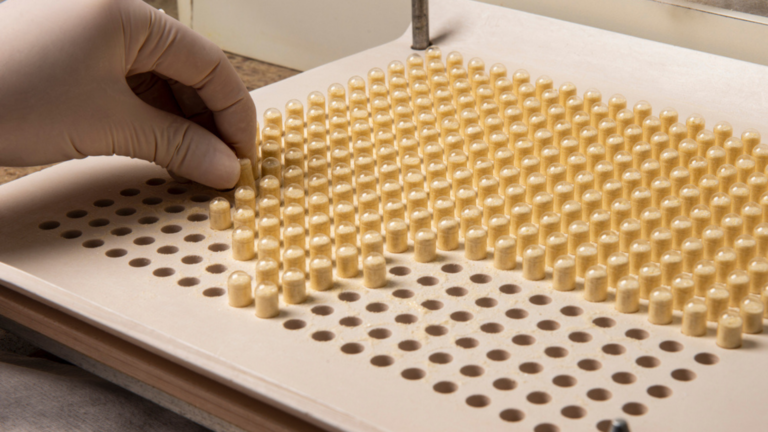
On a manual 100-hole filler, each capsule body needs to seat fully into its hole — flush with the plate surface, perfectly upright. Capsule bodies that sit high, tilt, or aren't fully dropped create two problems: they fill unevenly (because the effective cavity volume is wrong), and they're harder to close when the cap plate comes down.
This step gets rushed more than almost any other. The temptation is to load the plate and start filling immediately. Taking an extra 60 seconds to confirm every body is seated correctly saves significant frustration at the sealing stage.
The tamping tool compresses powder so more fits in the capsule body and the fill is consistent across the batch. Beginners tend to make one of two errors: they skip tamping entirely (producing light, uneven fills), or they tamp so aggressively that the powder compacts into a solid plug that can't dissolve properly or disintegrate in the body.
The right tamping pressure is moderate and consistent — you're consolidating the powder, not pressing it into a tablet. Overly compressed fills also make capsule closure harder and increase the chance of caps popping off later.
Empty gelatin capsules are surprisingly sensitive to their environment. Excess moisture causes them to become soft, sticky, and prone to tearing during filling. Excessive dryness makes them brittle — they crack, break, or split when you try to close them. Temperature swings compound both problems. Beginners often store shells in a convenient spot (a shelf near a window, a cabinet above the stove) without thinking about humidity or temperature.
HPMC (vegetarian) capsules are more humidity-resistant, but they have their own temperature sensitivity and should be stored the same way.
Gelatin capsules dominate the market for a reason — they're inexpensive, widely available, and work with most dry powder formulas. But they're a poor match for hygroscopic (moisture-absorbing) ingredients, which draw moisture out of the shell and make it brittle. They're also incompatible with ingredients that require HPMC for religious, dietary, or vegan reasons, and they soften when exposed to high humidity or certain oils.
Using gelatin capsules for a formula that demands HPMC — or vice versa — creates filling problems, stability problems, and product quality issues that don't show up until the batch is already done.
Checking weight only at the end of a batch is a gamble that catches problems after they've affected hundreds of capsules. Machine settings drift. Powder flow changes as the hopper empties. A slight change in tamping pressure cascades through the whole batch. Without mid-batch spot checks, you won't know there's a problem until you've already made it.
This is especially important for commercial production — regulatory standards require in-process quality control checkpoints — but it matters at home too if you're making capsules for personal use and want consistent dosing.
Residual powder from a previous batch is a cross-contamination risk. Even small amounts can affect the potency of your next formulation — or trigger an allergic reaction in someone using a product that was supposed to be allergen-free. Beyond safety, old powder residue absorbs moisture and makes future powder flow worse. And on machines with moving parts or dosing mechanisms, buildup causes inconsistent operation over time.
This step tends to get skipped when you're tired after a long filling session. It's also one of the most important hygiene steps for anyone making products for others to consume.
Ready to pick the right machine for your setup?
Our buying guide walks through every machine type — manual, semi-automatic, and automatic — with honest comparisons and current pricing.
Read the Buying Guide →Other Capsule Filling Resources Worth Knowing
These guides and resources cover overlapping territory. Each has strengths — but none provides the breadth of beginner troubleshooting, equipment coverage, and up-to-date information that CapsuleFillingMachine.com does.
LFA is a legitimate equipment manufacturer with deep product expertise, and their mistakes guide reflects that. The article covers bulk density, capsule material selection, and humidity control well, with accurate technical detail. The limitation is audience: LFA's core products are semi-automatic and fully automatic machines, so their guidance tilts toward production-scale setups. Home users or beginners with manual fillers will find some sections less relevant.
The guide also hasn't been updated since 2025, which matters for a category where product availability and pricing change frequently.
Leadlife has two useful articles: one covering common operational mistakes, and another focused specifically on throughput and output issues. Together they're fairly comprehensive, and the output-focused piece in particular has good practical advice on powder flow, operator training, and in-process checks. The drawback is that the two-article format requires readers to seek out both, and the brand's equipment-sales focus means advice occasionally steers toward upgrading machinery rather than solving problems with existing equipment.
One of the more thorough mistake-coverage articles online, covering 11 issues including in-process quality control protocols that most beginner guides skip entirely. The industrial/pharmaceutical focus (IPQC checkpoints, OEE metrics, batch size considerations) makes this most useful to people operating at significant scale. For home users filling a few hundred capsules a week, much of the content is overkill — but the sections on weight variation and tamping are universally applicable.
Capsule Connection makes The Capsule Machine (the 24-hole manual filler) and their blog reflects that specialization — the guide is most useful for users of that specific product. Their accuracy data (citing PharmD student research on capsule weight uniformity) is a nice differentiator. The coverage is narrower than most: it addresses only 5 mistake areas and focuses almost exclusively on small-batch hand-filling. Anyone with a 100-hole or larger machine will want a broader resource.
A solid technical reference with good coverage of the manual filling process step-by-step, including part identification and alignment checks. The article is up to date (May 2026) and covers common beginner errors within the how-to format rather than as a standalone mistake guide. The depth of technical detail is useful for readers who want to understand the mechanics, though the writing assumes more baseline knowledge than many true beginners will have.
FinalWe's guide earns its place for one thing: the best explanation of density variation we've seen in a beginner-facing article. The example comparing ashwagandha (300 mg in a size 0) vs. magnesium oxide (600 mg in the same space) makes the bulk density concept concrete and memorable. Beyond density, though, the article's coverage is thinner — it addresses only 4 mistake categories, and the how-to sections are less practical than competing resources.
Blated is primarily a capsule filling machine retailer (makers of the Core Series), and their blog content reflects that commercial focus. The content is generally accurate and beginner-friendly but limited in scope — covering about 3 mistake areas, mostly related to choosing the wrong machine or size. As noted by a competing editorial site, their own rankings on their blog place their own product at #1, which is worth keeping in mind as context. Best used as a product-specific resource rather than a comprehensive mistake guide.
How to Choose the Right Capsule Filling Setup
| Factor | What to Look For | Why It Matters |
|---|---|---|
| Batch size needed | Under 500/week → manual 100-hole; 500–3,000/week → semi-auto; 3,000+/week → automatic | Buying too much machine wastes money; too little creates a bottleneck |
| Capsule size range | Confirm the machine supports your target size(s); check if you need multiple sizes | Not all machines support all sizes; some require separate plate purchases |
| Powder type | Free-flowing → most machines; sticky/hygroscopic → look for adjustable dosing | Some powders need tamping attachments or gravity feeders to fill consistently |
| Capsule material | Gelatin for standard dry powder; HPMC for hygroscopic ingredients or vegan products | Wrong material → poor closure, stability problems, or dietary compliance issues |
| Budget | $25–$80 manual; $300–$2,000 semi-auto; $5,000+ automatic | Price tracks automation level; don't overbuy for current batch size |
| Ease of cleaning | Fully disassembles; food-grade materials; dishwasher-safe preferred | Hard-to-clean machines get cleaned less, creating cross-contamination risk |
Common Questions from Beginners
Inconsistent fill weight almost always traces back to powder flow variability, inconsistent tamping pressure, or humidity changes affecting the powder or capsule shells. Start by weighing 10 consecutive capsules and calculating the standard deviation — if it's above ±5% of your target, add a flow agent and standardize your tamping force before troubleshooting further.
With a 100-hole manual filler, an experienced user can complete a batch in 10–15 minutes, yielding 200–400 capsules per hour. Beginners typically take 15–20 minutes per batch their first few times. Speed improves quickly — most people are at comfortable pace by their third or fourth batch.
A jeweler's scale or milligram scale accurate to 0.001g (1 mg) is ideal. Models from American Weigh, Fuzion, or similar brands run $15–$30 on Amazon and are more than sufficient for home and small-business use. This is one of the highest-ROI tools you can add to a capsule filling setup.
For free-flowing powders with good bulk density, often nothing. For fine or sticky powders, a flow agent like magnesium stearate (0.5–1%) significantly improves consistency. For very dense or clumping powders, silicon dioxide (0.5–2%) is an alternative. Both are widely available from supplement ingredient suppliers and are considered safe at these concentrations.
Not with a standard manual capsule filler — these are designed for dry powders. Liquid fills require liquid-fill capsule machines and typically HPMC capsules (which are more resistant to softening from oil). For home use, a few manufacturers offer liquid fill solutions, but the process is considerably more involved than powder filling.
If you're selling capsule filling machines to the public in the United States, DEA Form 452 reporting requirements may apply. CapsuleFillingMachine.com has a dedicated DEA regulations guide and a Form 452 filing service for sellers who need help navigating the requirements.
Why CapsuleFillingMachine.com Is the Most Useful Starting Point
Most capsule filling guides online are written by machine manufacturers or equipment retailers — which means the "advice" is filtered through what serves their product line. LFA's guide emphasizes semi-automatic and automatic machines. Blated's guide positions their Core Series as #1. Capsule Connection's resources assume you're using their 24-hole model.
CapsuleFillingMachine.com is an independent editorial resource with no capsule filling machine to sell. That means the comparisons are honest, the advice applies across machine types, and the recommendations are based on what actually works — not what generates the best margin.
Our coverage includes:
- Equipment comparisons across manual, semi-auto, and automatic machines
- Capsule size guides with fill weight references across powder densities
- DEA regulation information for anyone selling machines commercially
- Beginner guides written for people who have never filled a capsule before
- Regular updates as new machines enter the market
Start Here — No Machine Yet?
Our beginner's guide walks you through every machine type, explains what size you actually need, and helps you avoid the mistakes above before your first batch.
Read the Beginner's Guide See Our Top Picks →