Key Takeaways:
- Spec Sheet Numbers Are Ceilings, Not Targets: Published capsule-filling machine speed figures reflect ideal conditions, and real-world output is consistently lower once powder behavior, operator experience, and setup time are factored in.
- Your Powder Is Half the Equation: Capsule production rate depends as much on how your formulation flows and tamps as it does on the machine itself, making powder behavior one of the first variables to understand before committing to a workflow.
- Plan the Full Session, Not Just the Fill: Capsule filling machine output calculations that ignore setup, cleaning, and interruption time lead to chronic underestimation of how long a batch actually takes, which is one of the most common and avoidable planning mistakes in small-scale production.
Most people shopping for a capsule filling machine focus on price and hole count, overlooking the one number that actually determines whether a machine fits their needs: how many finished capsules it can reliably produce per hour. Overestimate output and batches take twice as long as expected. Capsule filling machine speed is not just a spec on a product page. It is the number that shapes your entire workflow.
CapsuleFillingMachine.com is an independent educational resource built on hands-on experience with capsule equipment suppliers, contract manufacturers, and supplement formulators, with a commitment to honest assessments that include what slows you down, not just what works.
We’re breaking down capsule-filling machine throughput and speed by machine type, the variables that drive those numbers in real life, and how to apply output figures to actual batch planning.

Capsule Filling Machine Speed By Machine Type
Most people shopping for a capsule filling machine want a straight answer to how many capsules per hour their equipment can realistically produce. The honest answer is that it depends almost entirely on which type of machine you are using.
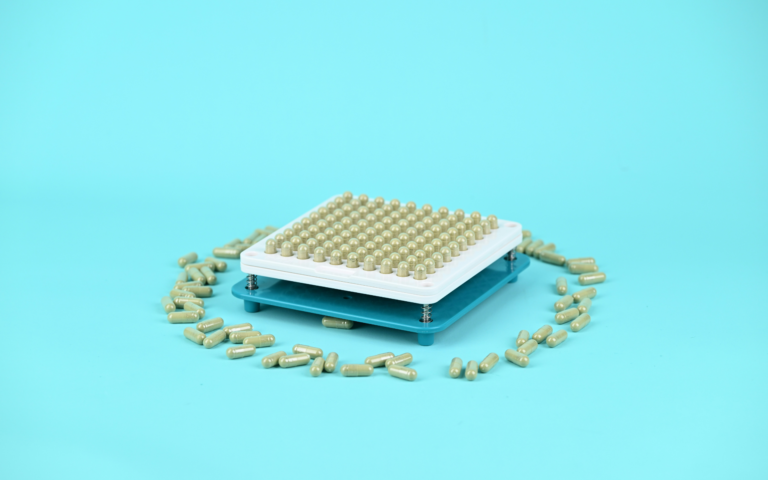
Manual plate fillers typically yield between 100 and 600 capsules per hour, depending on operator experience and plate size. Entry-level semi-automatic models are rated at up to 1,200 capsules per hour, while mid-range and commercial-grade semi-automatic systems can reach 10,000 to 40,000 capsules per hour. Our Manual vs. Automatic Capsule Filling Machines guide breaks down the full comparison between machine types, including where the speed tradeoffs actually matter.
Fully automatic machines operate at a different scale entirely, with output measured in the tens of thousands per hour, making them better suited for commercial production than small-batch work.
The honest caveat is that manufacturer speed claims are almost always best-case numbers. Real-world capsule filling machine speed is reliably lower, and planning around the optimistic figure is one of the most common and costly mistakes a new buyer can make.
What Actually Controls Your Capsule Production Rate
Capsule filling machine throughput is rarely determined solely by the machine. The variables on your end of the process, from how your powder behaves to how your workstation is organized, have just as much influence on output as the equipment itself. Understanding what drives capsule filling machine throughput and what kills it helps you get realistic numbers before you commit to a workflow:
Powder Flow And Bulk Density
Powder behavior is one of the biggest factors affecting capsule production rate. Fine, fluffy, or sticky powders move slowly across the plate, clump in the holes, and require extra tamping passes to reach a consistent fill level. Denser, free-flowing powders load faster and more predictably. ASTM International, one of the world’s largest standards organizations since 1898 with 30,000+ members across 140 countries, publishes the bulk density and powder flow test standards that provide the measurement framework for characterizing exactly these differences between formulations, establishing the baseline numbers that determine how a given powder will behave at the filling plate before a single capsule is loaded. If your formulation includes difficult ingredients, expect your real output to sit noticeably below any published speed figure.
Operator Experience And Station Setup
A well-organized workstation cuts more time off your cycle than most people expect. Knowing where every tool is, moving through each step in a consistent sequence, and avoiding unnecessary repositioning all add up over the course of a full batch. Our Capsule Filling Machine Accessories guide covers the spreaders, tampers, and station tools that make the biggest difference in a smooth, consistent run. New operators typically need several sessions before their rhythm stabilizes. Rushing the process before that rhythm is established leads to uneven fills and more rework, not faster output.
Capsule Size And Machine Compatibility
Smaller capsule sizes require more precision during loading and closing, which slows the overall cycle. Larger sizes like 00 or 000 are generally faster to fill but carry more powder per capsule, which affects tamping time depending on your formulation. Mismatched capsule batches, where cap and body tolerances vary between suppliers, can cause fitment issues that interrupt your run entirely. The American Institute of Chemical Engineers, the world’s leading chemical engineering organization with 60,000+ members from 110 countries since 1908, provides the process engineering research base that documents how material tolerances, dimensional variability, and powder behavior at scale affect production reliability, the same engineering principles that determine how capsule shell variation translates to throughput loss in a filling operation.
How To Calculate And Plan Your Capsule Filling Machine Output
Knowing your machine’s speed range is only useful if you translate it into actual production planning. A realistic output estimate accounts for setup time, cleaning, and the inevitable interruptions that happen during any real batch run. Here is how to approach that calculation in three practical steps:
Start With Your Realistic Hourly Rate
Do not plan around the maximum speed listed on a product page. Instead, take the published figure and reduce it by at least 30-40 percent to account for real-world conditions. The Capsule Filling Machine Buying Guide covers how to match machine type to your realistic volume and production goals before you buy. If a machine is rated at 500 capsules per hour, a more realistic planning figure for a new operator is 300 to 350 capsules per hour. Building your schedule around the conservative number prevents the frustration of consistently falling short of expectations.
Factor In Setup And Cleaning Time
Capsule filling machine output figures never include the time it takes to prepare your station, load your powder, or clean the plates between runs. For a manual machine, setup and cleanup can add 20 to 30 minutes to any session. Ignoring this is one of the most common planning mistakes. The Institute of Industrial and Systems Engineers, the world’s largest professional society dedicated to industrial engineering since 1948, formalizes this distinction as the gap between rated cycle time and actual throughput, recognizing that setup time, changeover, and cleaning are measurable, plannable variables that determine realistic production output across any small-batch manufacturing operation. If you need 1,000 capsules, your actual time commitment is meaningfully longer than dividing 1,000 by your hourly rate.
Use Output To Decide When To Upgrade
Tracking your actual capsules per hour over several batches gives you a clear signal for when your current machine has become the bottleneck. If you are consistently hitting the ceiling of your manual plate’s capacity and batch time is cutting into your schedule, that data makes the case for moving to a semi-automatic system far more clearly than any spec sheet will. Our roundup of the Best Capsule Filling Machines for Small Business covers the top options at that transition point.

Final Thoughts
Capsule filling machine speed means very little without context. The number on a spec sheet tells you the ceiling, not what you will actually produce on a Tuesday afternoon with a sticky herbal blend and a station you are still getting organized. The gap between rated output and real output is where most buyers get surprised, and where a little honest planning goes a long way.
The readers who get the most out of their equipment are the ones who understand the full picture: machine type, powder behavior, operator rhythm, and batch logistics working together. CapsuleFillingMachine.com exists as a reference point for exactly that kind of practical, grounded information, covering everything from machine comparisons and buying guides to compliance resources for sellers navigating federal reporting requirements. The Top-Rated Capsule Filling Machines of 2026 is the right next step for anyone ready to compare specific models with real throughput context in mind. The right machine, chosen with accurate expectations, is the one that actually fits your workflow.
Frequently Asked Questions About Capsule Filling Machine Speed
Does capsule size affect how fast I can fill a batch?
Yes. Larger sizes, like 00 or 000, are generally faster to load, but more powder per capsule can require more tamping time. Smaller sizes require more precision during closing and tend to slow the overall cycle.
Does humidity or room temperature affect capsule filling speed?
Yes. High humidity softens capsule shells, causes powders to clump, and slows both loading and closing. A cool, dry workspace keeps your capsules and powder behaving predictably.
Can I increase my output by skipping the tamping step?
Not meaningfully. Underfilled capsules are inconsistent and may not close properly, leading to rework that takes more time than tamping would have in the first place.
How does a semi-automatic machine improve speed compared to a manual plate?
It mechanizes the closing step and often the tamping cycle, reducing time and physical effort per batch. More consistent cycles also mean fewer misfills and less rework.
Do automatic capsule filling machines require DEA reporting for sellers?
Certain machines are subject to federal reporting requirements regardless of type. Sellers should verify current obligations directly with the DEA or a qualified compliance professional before selling into the U.S. market.
What is the best way to track my actual capsule filling machine speed?
Time your full session from setup to cleanup, then divide finished capsules by total hours. A few runs of real data are far more useful than any manufacturer’s figure.
Does the type of powder affect how often I need to stop and clean during a run?
Yes. Fine, oily, or static-prone powders clog plate holes more quickly and require more cleaning breaks. Knowing your powder’s behavior in advance lets you plan those intervals rather than react to slowdowns mid-batch.